Advent of Europeans in India
#
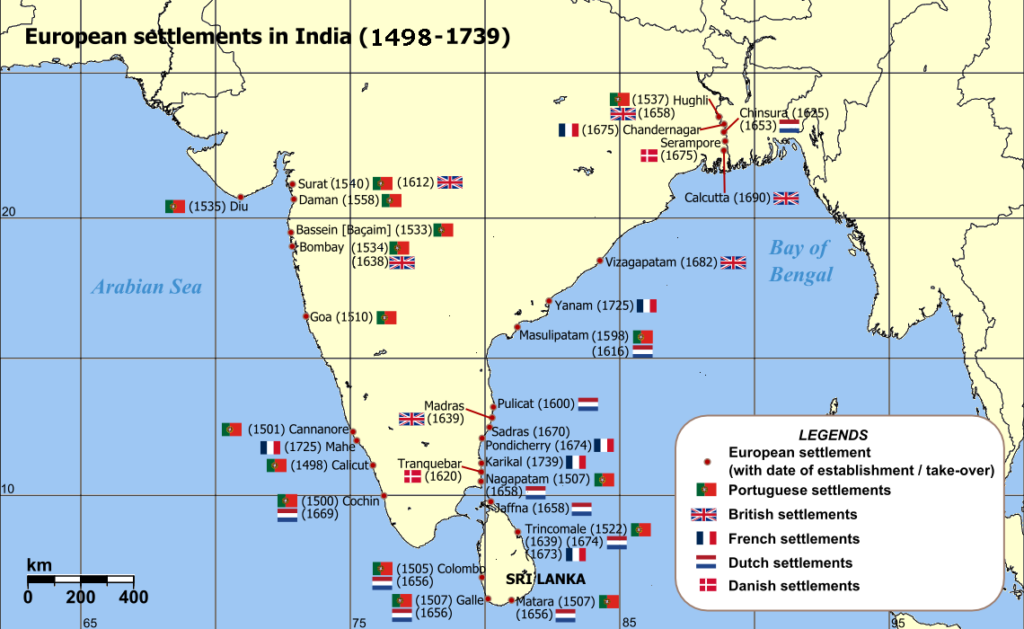
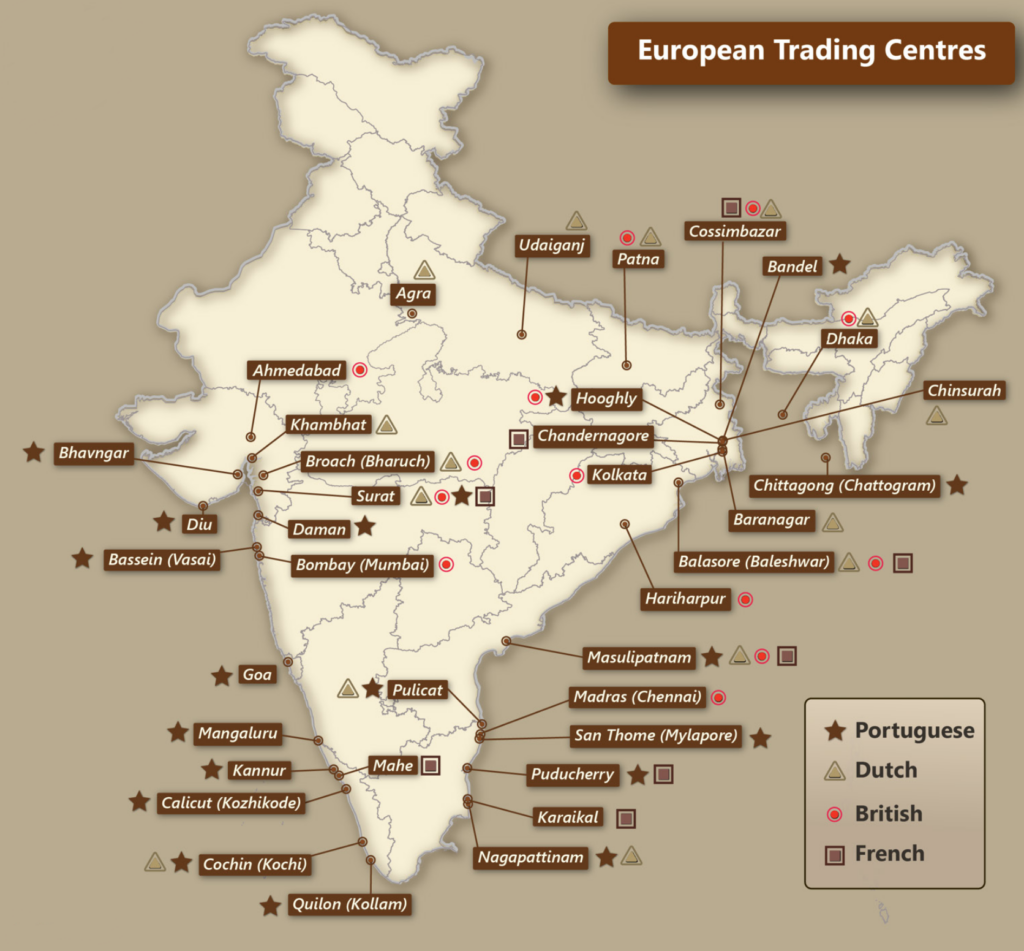
The arrival of Europeans in India began with the search for a direct sea route to the East. The Portuguese were the first to arrive, while the British ultimately established political supremacy.
Order of Arrival and Company Formation
#
European Power
Arrival / Company
First Important Centre
Key Person
Portuguese 1498 Calicut; first factory at Cochin
Vasco da Gama
English 1600 charter; 1608 arrivalSurat
Queen Elizabeth I, William Hawkins
Dutch 1602 VOCMasulipatnam; later Pulicat
Dutch East India Company
Danish 1616 companyTranquebar
Danish East India Company
French 1664 companySurat; later Pondicherry
Colbert, Francois Caron
Arrival sequence: Portuguese -> English -> Dutch -> Danish -> FrenchCompany sequence: English (1600) -> Dutch (1602) -> Danish (1616) -> French (1664)
Portuguese in India
#
The Portuguese were the first Europeans to arrive and the last Europeans to leave India .
Fact
Detail
Vasco da Gama Reached Calicut on 20 May 1498 ; welcomed by Zamorin.
Pedro Alvarez Cabral Established the first Portuguese factory at Cochin .
Francisco de Almeida First Portuguese Governor in India; followed Blue Water Policy .
Battle of Diu 1509 ; Portuguese defeated a combined naval force and strengthened control over the Arabian Sea.
Alfonso de Albuquerque Real founder of Portuguese power in India; captured Goa in 1510 from Bijapur.
Nino da Cunha Shifted Portuguese headquarters from Cochin to Goa in 1530 .
Treaty of Bassein 1534 ; Portuguese obtained Bassein and influence near Bombay.
Cartaz system Naval pass system used to control sea trade.
Important settlements Goa, Cochin, Diu, Daman, Bassein, Salsette, Hooghly.
Introductions Tobacco, potato, printing press, and new crops/food habits.
First printing press Goa, 1556 .
End of Portuguese rule Goa, Daman, and Diu were liberated in 1961 .
Decline of the Portuguese
#
Reason
Fact
Religious intolerance Forced conversions and missionary excesses created resentment.
Corruption Officials often focused on private trade and personal profit.
Weak successors Later Portuguese governors lacked Albuquerque’s ability.
Competition Dutch, English, and French challenged Portuguese sea power.
Focus shifted Portugal’s attention shifted after Brazil became important.
Dutch in India
#
The Dutch were mainly interested in the spice trade of Indonesia , so India remained secondary for them.
Fact
Detail
Company name Dutch East India Company, or VOC , formed in 1602 .
First factory Masulipatnam, 1605 .
Headquarters Pulicat was early HQ; later shifted to Nagapattinam.
Important centres Masulipatnam, Pulicat, Surat, Chinsura, Kasimbazar, Patna, Balasore, Nagapattinam, Cochin.
Exports from India Cotton textiles, indigo, saltpetre, opium, raw silk.
Battle of Bedara / Chinsura 1759 ; English defeated the Dutch.
Decline Dutch focus shifted to Indonesia; English naval and commercial power increased.
English in India
#
Fact
Detail
English East India Company Chartered by Queen Elizabeth I on 31 December 1600 .
First English arrival Captain William Hawkins arrived at Surat in 1608 on the ship Hector .
Hawkins at court Visited Jahangir’s court in 1609 .
Battle of Swally 1612 ; English defeated the Portuguese near Surat.
Surat factory Established in 1613 .
Sir Thomas Roe Ambassador of James I; visited Jahangir’s court in 1615 and secured trade privileges.
Masulipatnam factory Early English factory on the Coromandel Coast.
Golden Farman Sultan of Golconda allowed English free trade in Golconda ports.
Madras Acquired in 1639 ; Fort St. George became the English base.
Bombay Given to Charles II as dowry by the Portuguese in 1661 ; transferred to EIC in 1668 .
Calcutta Developed from Sutanuti, Govindpur, and Kalikata ; Job Charnock associated with 1690.
Fort William Built at Calcutta around 1700 .
Farrukhsiyar’s Farman 1717 ; called the Magna Carta of the East India Company ; allowed duty-free trade in Bengal.
Child’s War 1686-1690 ; conflict between EIC and Aurangzeb, ending in English apology.
English Presidency Towns
#
Presidency
Important Centre
Fact
Madras Fort St. George
First major English base in south India.
Bombay Bombay Island
Became important after transfer from the Portuguese.
Bengal Calcutta / Fort William
Became the strongest English centre in eastern India.
Danish in India
#
Fact
Detail
Company Danish East India Company, 1616 .
First settlement Tranquebar, 1620 .
Bengal settlement Serampore, 1755 .
Head office Serampore.
Serampore missionaries William Carey, Joshua Marshman, William Ward.
End Danish settlements were sold to the British in 1845 .
French in India
#
The French were the last major European trading power to enter India.
Fact
Detail
French East India Company Formed in 1664 by Colbert under Louis XIV.
First factory Surat, 1668 .
Masulipatnam factory Established in 1669 .
Pondicherry Acquired in 1673 ; became the main French centre.
Chandernagore Established in Bengal in 1690 .
Francois Martin Founder and first major governor of Pondicherry.
Dumas Strengthened French position in south India.
Dupleix Most important French governor; began active interference in Indian politics.
Lally French commander defeated in the Battle of Wandiwash.
Bussy Important French officer in the Deccan.
French Settlements
#
Settlement
Region
Pondicherry Tamil coast
Chandernagore Bengal
Mahe Malabar coast
Karaikal Tamil coast
Yanam Andhra coast
Carnatic Wars
#
War
Period
Main Cause / Event
Result
First Carnatic War 1746-1748 Extension of Anglo-French rivalry in Europe; French captured Madras.
Treaty of Aix-la-Chapelle; Madras restored to English.
Second Carnatic War 1749-1754 Succession disputes in Hyderabad and Carnatic.
Treaty of Pondicherry; Dupleix recalled.
Third Carnatic War 1758-1763 Seven Years’ War background; decisive Anglo-French struggle.
French defeated; Treaty of Paris, 1763.
Key Battles and Treaties
#
Event
Year
Parties
Result / Importance
Battle of Diu 1509 Portuguese vs combined naval forces
Portuguese naval supremacy strengthened.
Battle of Swally 1612 English vs Portuguese
English gained importance at Surat.
Treaty of Bassein 1534 Portuguese and Gujarat ruler
Portuguese got Bassein.
Treaty of Aix-la-Chapelle 1748 English and French
Ended First Carnatic War; Madras restored.
Treaty of Pondicherry 1754 English and French
Ended Second Carnatic War; Dupleix recalled.
Battle of Bedara / Chinsura 1759 English vs Dutch
Dutch power in India declined.
Battle of Wandiwash 1760 English vs French
Eyre Coote defeated Lally; French hopes declined.
Treaty of Paris 1763 English and French
French factories restored but fortification and politics restricted.
High-Yield One-Liners
#
Vasco da Gama reached Calicut in 1498 .Almeida is linked with Blue Water Policy .Albuquerque is the real founder of Portuguese power in India.Goa was captured by the Portuguese in 1510 .Nino da Cunha shifted Portuguese headquarters to Goa.Cartaz was the Portuguese naval pass system.Dutch first factory was at Masulipatnam .Dutch headquarters shifted from Pulicat to Nagapattinam .English East India Company was formed in 1600 .William Hawkins came on the ship Hector .Sir Thomas Roe came to Jahangir’s court as ambassador of James I.Battle of Swally, 1612 weakened Portuguese influence near Surat.Madras is linked with Fort St. George .Calcutta grew from Sutanuti, Govindpur, and Kalikata .Farrukhsiyar’s Farman, 1717 is called the Magna Carta of EIC .Danes are linked with Tranquebar and Serampore .Colbert founded the French East India Company in 1664 .Francois Martin is linked with Pondicherry .Dupleix began French interference in Indian politics.Battle of Wandiwash, 1760 ended French hopes of political power in India.Eyre Coote defeated Lally at Wandiwash.